Doyle Brunson
The Godfather of Aggression. Why pressure wins pots you never deserved to win.
For players who know the rules but still guess too often
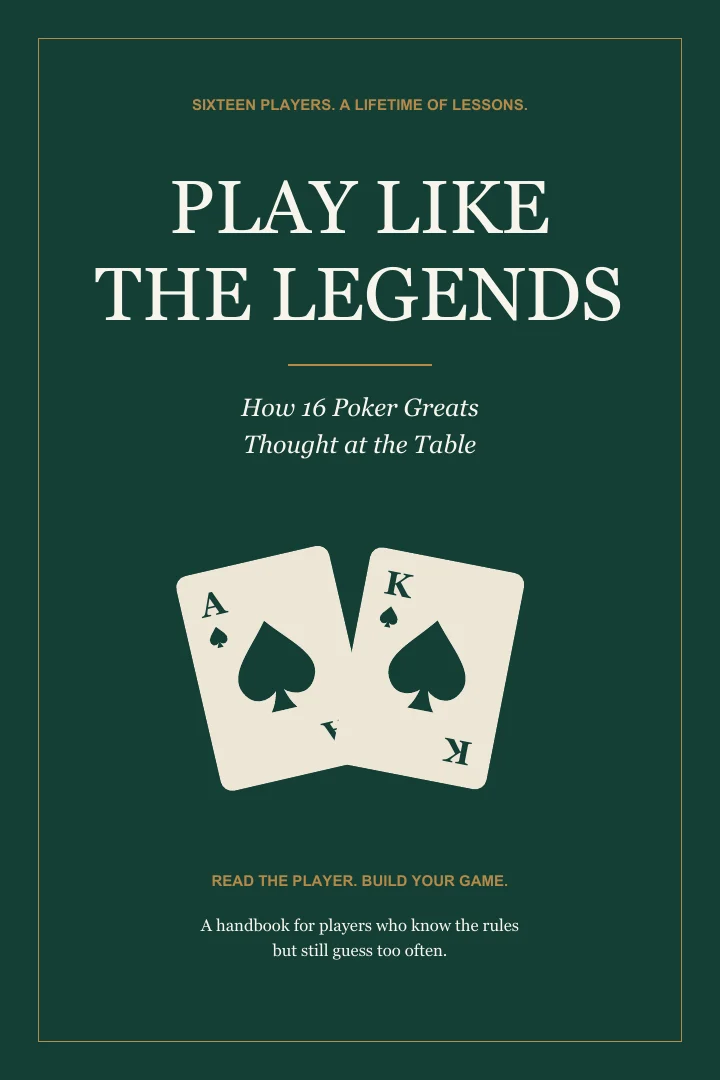
Doyle Brunson's pressure. Stu Ungar's reads. Phil Ivey's adjustments. Doug Polk's ranges. Sixteen of the greatest players who ever sat at a table, broken down into the decisions that made them dangerous, plus a training hand in every chapter that makes you use them.
The uncomfortable truth
You know the rules. You know the hand rankings. You've probably watched hours of poker on YouTube. And still, the river comes, someone bets big, and you sit there doing the one thing that bleeds more money than any bad beat: guessing.
Most poker books tell you what to do. Raise this, fold that, bet this size. Fine, until a real person across the table does something the chart never mentioned. Then you're on your own, with seconds to decide and chips on the line.
The legends were never great because they memorized more charts. They were great because they had a way of thinking: a short set of principles that told them what mattered in each spot and what to ignore.
Brunson thought about pressure. Ungar thought about whether his opponent's story made sense. Chip Reese thought about which game to sit in before he looked at a single card. Dan Harrington thought about how many orbits he could survive.
This book hands you all sixteen ways of thinking, then makes you prove you can use them.
The lineup
Each chapter strips a legend down to the two or three principles that made them dangerous, then shows you exactly where those principles break.
The Godfather of Aggression. Why pressure wins pots you never deserved to win.
The art of being unpredictable. Steal relentlessly and never let them read you.
Make every opponent's decision miserable, then profit from their mistakes.
Pick your target. Find the timid player and attack them without mercy.
Fearless reads. When the story doesn't add up, trust it and call.
Small ball and hand reading. Put your opponent on a range, street by street.
Reads, patience and the brutal price of tilt.
Watch before you act. Patience and endurance as a weapon.
The most profitable decision in poker happens before you sit down.
Let your stack decide your strategy. Survive tournaments with M.
Forty years at the top by refusing to stop adapting.
Set the terms. Turn your table image into money.
The patient trap. Know exactly when to let them bet for you.
The amateur's edge. Courage, timing and a story the board supports.
Adjust to the player, not the textbook, and fight back when you're targeted.
Think in ranges and frequencies. Know whose flop it really is.
Ungar, Hansen, Archie Karas. Five bankroll rules so their story never becomes yours.
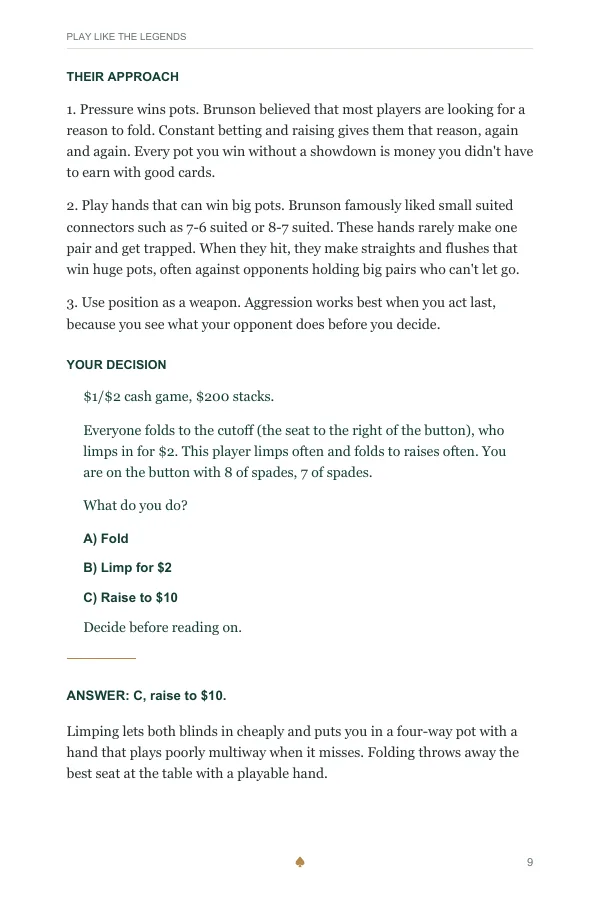
Your decision · Chapter 1
Every chapter has a hand like this one. You stop, you commit to an answer, then you read the legend's reasoning. Reading an answer teaches you very little. Committing to one teaches you a lot.
Everyone folds to the cutoff, who limps in for $2. This player limps often and folds to raises often. You're on the button with:
What do you do?
The chapter goes on: the follow-up flop, what to steal from Brunson's style, exactly when it backfires, and a drill for your next session. Fifteen more hands like this are waiting.
Unlock All 16 Hands · $17Inside every chapter
Every legend gets the same six-part treatment, so you finish each chapter with something you can use in your very next game.
Who they were, how they rose, and the moments that made them famous.
The two or three principles that defined how they actually played.
A training hand built to test their thinking. Commit before you read on.
Concrete adjustments to take straight into your home game or card room.
Every style has a leak. Knowing it is the difference between using a style and copying it.
One exercise for your next session. Small, specific, measurable.
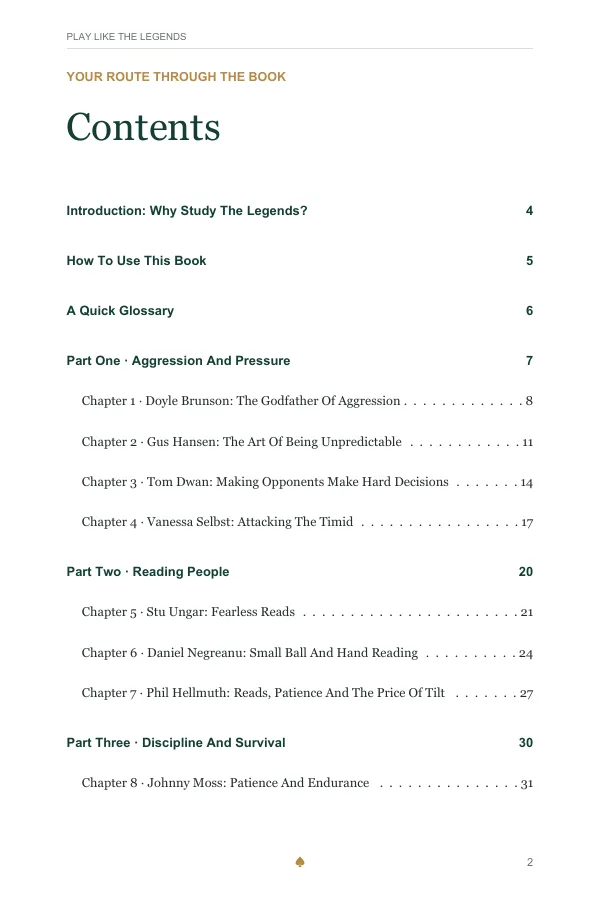
Look inside
No 400-page doorstop. No walls of theory. Just the ideas that matter, laid out so you can reread a chapter the night before you play.
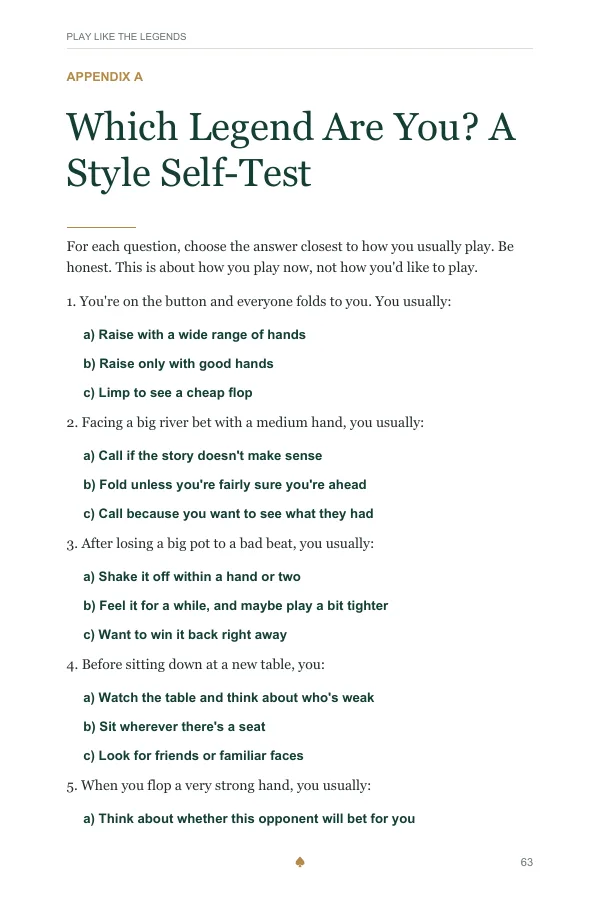
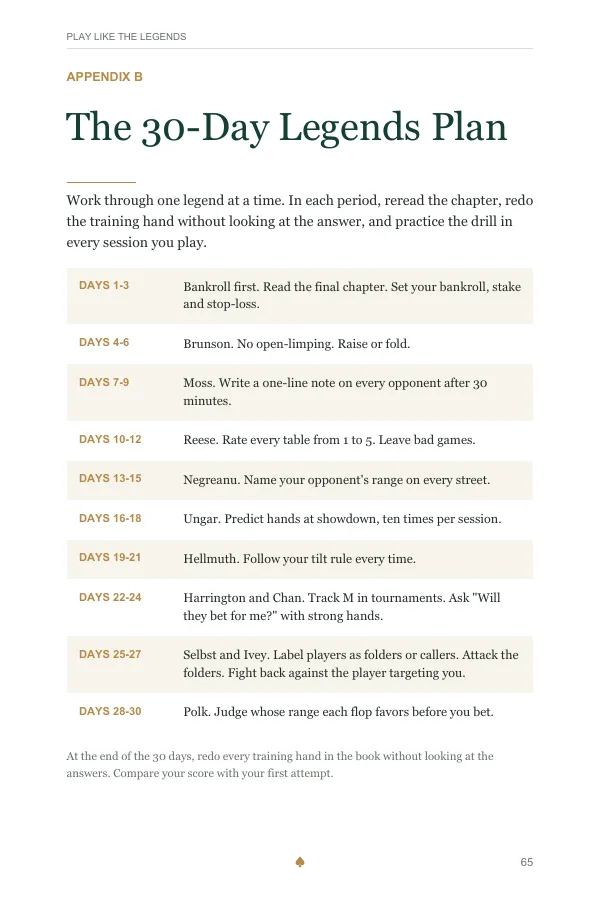
The chapter most books won't write
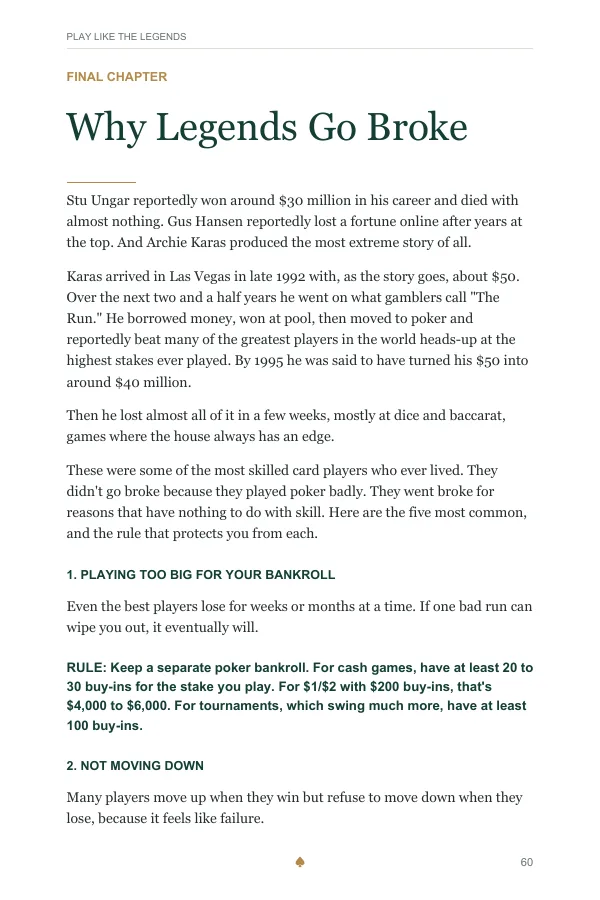
Stu Ungar reportedly won around $30 million and died with almost nothing. Archie Karas reportedly turned about $50 into roughly $40 million, then lost nearly all of it in a few weeks.
They didn't go broke because they played poker badly. They went broke for reasons that have nothing to do with skill. The final chapter breaks down the five most common, and gives you the rule that protects you from each one.
Who this is for
You play every week and you're tired of being the friend everyone's happy to see. You want to stop paying for everyone else's pizza.
You know the basics but keep running into spots no chart covers. Every hand in the book is played at $1/$2, 100 big blinds. Your game.
You bust in the middle stages and can't say why. Harrington's M, Hansen's steals and Moneymaker's timing were made for you.
Play Like the Legends
Learn how sixteen of the greatest players in history thought at the table. Test yourself in sixteen training hands. Then follow a 30-day plan that turns their lessons into your habits.
One avoided mistake at a $1/$2 table pays for this book several times over. One fewer hero call. One fewer limp. One night you walk away instead of chasing.
Get the Book Now · $17Read it. Solve the hands. Take it to the table. If it doesn't change the way you think about your decisions, send one email within 30 days and get a full refund.
Questions
It's written for players who know the rules and have played real hands. There's a quick glossary up front, but if you don't yet know what beats a flush, learn the basics first.
Each chapter ends with "When It Backfires", and that's where experienced players get the most value. Knowing the limits of a style is what separates using it from copying it.
Both. Most training hands are $1/$2 no-limit hold'em with 100 big-blind stacks, the most common game in casinos and card rooms. Several chapters, including Hansen, Harrington and Moneymaker, focus on tournament spots.
Most training hands are built scenarios designed to put you in the kind of spot each legend was famous for. Where a chapter describes a real historical hand, it says so. Disputed stories are marked "as the story goes".
You get the PDF download as soon as your payment clears. No shipping, no subscription. It reads on your phone, tablet or computer.
Email within 30 days for a full refund. No hoops.
P.S. Every one of these sixteen players was once a beginner who guessed too often. What made them legends was that they kept thinking, kept watching and kept learning. The book gives you their playbook. The training hands make you use it.
P.P.S. It's $17, delivered instantly, with a 30-day guarantee. That's less than one bad river call at a $1/$2 table.
Get Play Like the Legends · $17